Monday, June 30, 2014

Submitting URL to Google Scholar

I help a friend setting up a digital conference proceeding minisite. It is the the Proceeding of the Global Summit on Education 2013. I suggest to submit the url to Scholar.google.com . It's actually a search engine based on Google for academic articles such as journals, proceedings, thesis and technical papers. In order to boost the Google Scholar visibility I submitted to that search engine.
Proceeding of the Global Summit on Education 2013
To submit your scholarly-content website, go to this URL,http://www.google.com/support/scholar/bin/request.py . Google scholar is getting popular to the academicians or researchers for their literature review and referencing. Hence, I would say it's a wise to submit the website to such service.

These are some guidelines;

    Your website has a separate URL for each article, as well as a browse interface that lists all article URLs. *
    Each article URL contains either the complete author-written abstract or the entire text of the paper. *
    All article URLs can be read by any user without a login or payment. *
    The robots.txt file on your website, if your website has one, allows Googlebot to crawl all article URLs as well as the browse interface. *
    My inclusion request is for a personal publication. *
    Detailed technical guidelines can be found at http://scholar.google.com/intl/en/scholar/inclusion.html.

Individual Authors

If you're an individual author, it works best to simply upload your paper to your website, e.g., www.example.edu/~professor/jpdr2009.pdf; and add a link to it on your publications page, such as www.example.edu/~professor/publications.html. Make sure that:

    the full text of your paper is in a PDF file that ends with ".pdf",
    the title of the paper appears in a large font on top of the first page,
    the authors of the paper are listed right below the title on a separate line, and
    there's a bibliography section titled, e.g., "References" or "Bibliography" at the end.

That's it! Our search robots should normally find your paper and include it in Google Scholar within several weeks.

If it doesn't work, you could either (1) read more detailed technical guidelines in this documentation or (2) check if your local institutional repository is already configured for indexing in Google Scholar, and upload your papers there.

University Repositories

If you're a university repository, we recommend that you use the latest version of Eprints (eprints.org), Digital Commons (digitalcommons.bepress.com), or DSpace (dspace.org) software to host your papers.

If you use a less common hosting product or service, or an older version of these, please read this entire documentation and make sure that your website meets our technical guidelines.

Journal Publishers

If you publish a small number of journals, consider using one of the established journal hosting services, e.g., alphabetically, Atypon, Highwire Press, MetaPress. Aggregators that host many journals on a single website, such as JSTOR or SciELO, often work too, but please check with your aggregator to make sure that they support full-text indexing in Google Scholar. Alternatively, if you have the technical expertise to manage your own website, we recommend the Open Journal Systems (OJS) software that's available for download from the Public Knowledge Project (PKP).

If you use a smaller journal hosting service, or if you maintain your own custom website, please read this entire documentation and make sure that your website meets our technical guidelines.

After almost two weeks of submission, one of the article appears in the Google Scholar search result;

Proceeding of the Global Summit on Education 2013 at Scholar.Google.com

- See more at: http://blog.kerul.net/2013/03/submitting-url-to-google-scholar.html#sthash.okOKmOMH.dpuf

Wednesday, June 25, 2014

International Conference on Experimental Mechanics (icEM2014), 13th Asian Conference on Experimental Mechanics (ACEM) from the 15-17 November 2014

The International Conference on Experimental Mechanics (icEM2014) will be held in conjunction with the 13th Asian Conference on Experimental Mechanics (ACEM) from the 15-17 November 2014, at the Holiday Inn Atrium Singapore.
The conference provides a dynamic platform, bringing together prominent academia, engineers, researchers and scientists from the international and regional communities, to engage in thought leadership sessions and interactive discussions on the areas of

  • Experimental Solid and Fluid Mechanics
  • Non-Destructive Testing and Smart Structures
  • Micro and Nano-Mechanics
  • Biomechanics and Life Sciences
  • Structural Dynamics and Vibration
  • Optics and Laser Applications and
  • Hybrid Methods and Image Processing

We invite you to submit your abstracts for the conference. Papers will be published in SPIE Proceedings (SCI Indexed).
Deadline for submission: 31 July 2014
Click here for abstract submission details

Source: http://icem2014.com.sg/

Monday, June 23, 2014

4th European Conference on Microfluidics 10th -12th December 2014 Limerick, Ireland

Microfluidics 2014 (μFlu’14) is the fourth European Conference on Microfluidics. This event takes place every two years and follows on from previous conferences held in Heidelberg (2012), Toulouse (2010) and Bologna (2008).

Limerick is the third city of the Republic of Ireland, situated in the South-West and accessible via Shannon International Airport, with direct flights from major US cities, the UK and Europe. It is two hours by car or train from Dublin. Ireland’s sporting capital, Limerick is home to the internationally renowned Munster Rugby team and is an ideal base to explore the main tourist attractions of the West Coast of Ireland (Cliffs of Moher, Ring of Kerry, the Burren landscape).

Welcome to Microfluidics 2014 (µFlu’14), the fourth European Conference on Microfluidics. This event takes place every two years and follows on from previous conferences held in Heidelberg (2012), Toulouse (2010) and Bologna (2008)

The aim of the conference is to foster increased linkages between European and International researchers in the Microfluidics sector, and to promote exchange between European Universities, Non-European Universities and Industrial Companies engaged in this field.

Microfluidics is a highly interdisciplinary field, with applications related to medicine, chemical and process engineering, transport, environmental sciences, microelectronics to name a few. Applied papers from Industries engaged in Microfluidics are particularly welcome. The Conference invites submission of abstracts describing original works on the following topics:

Nanofluidics
Microfabrication
Lab on a Chip
Biomicrofluidics
Mixing / Mass Transport in Microfluidics
Visualization of Microflows
Multiphase and Reacting Microflows
Digital Microfluidics
Special Topic: Thermal Management of Electronics
Electrohydrodynamics
Boiling / Phase Change Phemomena
Gas Microflows
Thermal Transport in Microfluidics
Sensors and Actuators
Droplet / Slug Flow Microfluidics

Source: http://microfluidics2014.eu/

Saturday, June 21, 2014

Prize \ Medals \ Awards

  • Fridtjof Nansen Medal , Ocean Sciences 
  • Augustus Love Medal, Geodynamics 
  • Hans Oeschger Medal,  Climate: Past, Present & Future
  Others: https://www.egu.eu/awards-medals/awards-and-medals/ 

Mathematics
  • The Fields Medals
  • The Nevanlinna Prize
  • The Gauss Prize
  • The Chern Meda

Wednesday, June 18, 2014

Highly Cited Researchers

Highly Cited Researchers 2014 represents some of world’s leading scientific minds. Over three thousand researchers earned the distinction by writing the greatest numbers of reports officially designated by Essential Science Indicators℠ as Highly Cited Papers—ranking among the top 1% most cited for their subject field and year of publication, earning them the mark of exceptional impact.

http://highlycited.com/

Prediction model for the FIFA World Cup 2014: Using statistical modeling techniques and R

Like a last minute goal, so to speak, Andreas Groll and Gunther Schauberger of Ludwig-Maximilians-University Munich announced their predictions for the FIFA World Cup 2014 in Brazil – just hours before the opening game.
Andreas Groll, with his successful prediction of the European Championship 2012 already experienced in this field, and Gunther Schauberger did set out to predict the 2014 world cup champion based on statistical modeling techniques and R.
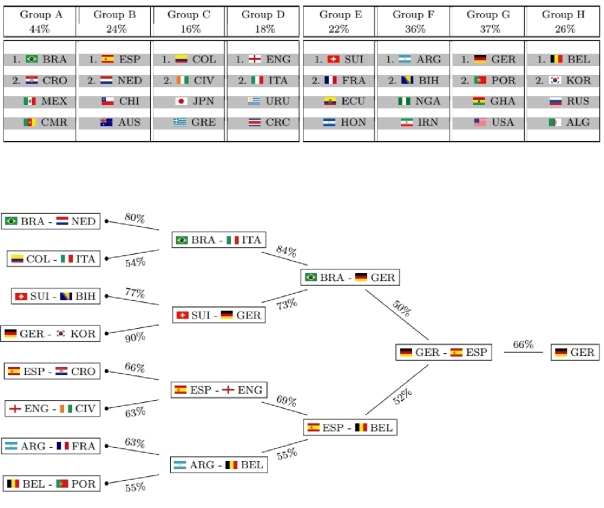
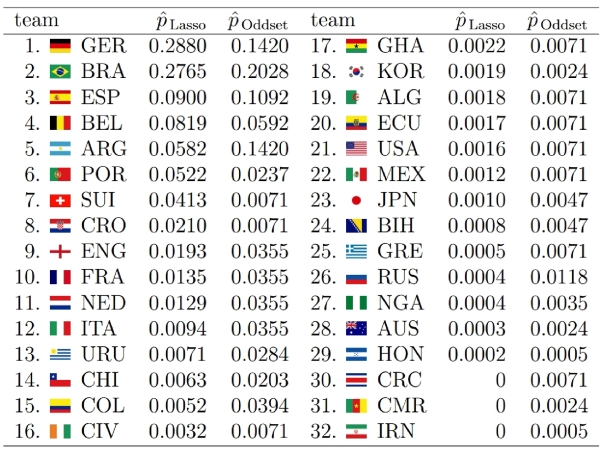
A bit surprisingly, Germany is estimated with highest probability of winning the trophy (28.80%), exceeding Brazil’s probability (the favorite according to most bookmakers) only marginally (27.65%). You can find all estimated probabilities compared to the respective odds from a German bookmaker in the graphic on their homepage (http://www.statistik.lmu.de/~schauberger/research.html), together with the most likely world cup evolution simulated from their model. The evolution also shows the neck-and-neck race between Germany and Brazil: they are predicted to meet each other in the semi-finals, where Germany’s probability of winning the game is a hair’s breadth above 50%. Although there does not exist a detailed technical report on the results yet, you still can get some insight into the model as well as the data used through a preliminary summary pdf on their homepage (http://www.statistik.lmu.de/~schauberger/WMGrollSchauberger.pdf).
probs-001-001.jpg tree-001-001.jpg
Last week, I had the chance to witness a presentation of their preliminary results at the research seminar of the Department of Statistics (a home game for both), where they presented an already solid first predictive model based on the glmmLasso R package. However, continuously refining the model to the last minute, it now did receive its final touch, as they published the predictions at their homepage.
As they pointed out, statistical prediction of the world cup champion builds on two separate components. First, you need to reveal the individual team strengths – “who is best?”, so to speak. Afterwards, you need to simulate the evolution of the championship, given the actual world cup group drawings. This accounts for the fact that even quite capable teams might still miss the playoffs, given that they were drawn into a group of hard competitors.
Revealing the team strength turns out to be the hard part of the problem, as there exists no simple linear ranking for teams from best to worst. A team that might win more games on average still could have its problems with a less successful team, simply because they fail to adjust to the opponents style of play. In other words: tough tacklings and fouls could be the skillful players’ death.
Hence, Andreas Groll and Gunther Schauberger chose a quite complex approach: they determine the odds of a game through the number of goals that each team is going to score. Thereby, again, the likelihood of scoring more goals than the opponent depends on much more than just a single measure of team strength. First, the number of own goals depends on both teams’ capabilities: your own, as well as that of your opponent. As mediocre team, you score more goals against underdogs than against title aspirants. And second, your strength might be unevenly distributed across different parts of the team: your defense might be more competitive than your offensive or the other way round. As an example, although Switzerland’s overall strength is not within reach to the most capable teams, their defense during the last world cup still was such insurmountable that they did not receive a single goal (penalty shooting excluded).
The first preliminary model shown in the research seminar did seem to do a great job in revealing overall team strength already. However, subtleties as the differentiation between offensive and defense were not included yet. The final version, in contrast, now even allows such a distinction. Furthermore, the previous random effects model did build its prediction mainly on the data of past results itself, referring to explanatory co-variates only minor. Although this in no way indicates any prediction inaccuracies, one still would prefer models to have a more interpretable structure: not only knowing WHICH teams are best, but also WHY. Hence, instead of directly estimating team strength from past results, it is much nicer to have them estimated as a result of two components: the strength predicted by co-variates like FIFA rank, odds, etc, plus a small deviation found by the model through past results itself. As a side effect, the model should also become more robust against structural breaks this way: a team with very poor performance in the past now still could be classified as good if indicators of current team strength (like the number of champions league players or the current odds) hint to higher team strength.
Building on explanatory variables, however, the efficient identification of variables with true explanatory power out of a large set of possible variables is the real challenge. Hence, instead of throwing in all variables at once, their regularization approach allows to gradually extend the model by incorporating the variable with best explanatory power among all not yet included variables. This variable selection seems to me to be the big selling point of their statistical model, and with both Andreas Groll and Gunther Schauberger having prior publications in the field already, they most likely should know what they are doing.
From what I have heard, I think we can expect a technical report with more detailed analysis within the next weeks. I’m already quite excited about getting to know how large the estimated distinction between offensive and defense actually turns out to be in their model. Hopefully, we will get these results at a still early stage of the running world cup. The problem, however, is that some explanatory variables within their model could only be determined completely when all the team’s actual squads were known, and hence they could start their analysis only very shortly prior to the beginning of the world cup. Although this obviously caused some delay for their analysis, this made sure that even possible changes of team strength due to injuries could be taken into account. I am quite sure, however, that they will catch up on the delay during the next days, as I think that they are quite big football fans themselves, and hence are most likely as curious about the detailed results as we are…

Source: http://www.r-bloggers.com/prediction-model-for-the-fifa-world-cup-2014/

Thursday, June 12, 2014

Montage: Create a composite image by combining several separate images

Use the montage program to create a composite image by combining several separate images. The images are tiled on the composite image optionally adorned with a border, frame, image name, and more. See Command Line Processing for advice on how to structure your montage command or see below for example usages of the command.

Example Usage

We list a few examples of the montage command here to illustrate its usefulness and ease of use. To get started, let's montage two images into a single composite:

$ montage -background #336699 -geometry +4+4 rose.jpg red-ball.png montage.jpg
Ok, let's add some decorations:
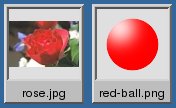
$ montage -label %f -frame 5 -background #336699 -geometry +4+4 rose.jpg red-ball.png frame.jpg

montage -geometry "1280x480" -tile 2x2 1.jpg 2.jpg 3.jpg 4.jpg montage.jpg 

Source: http://www.tutorialspoint.com/unix_commands/montage.htm